Tars: Multi-Model Routing for AI Trading
The Cost Problem
Running an AI trading system is expensive. If every LLM call uses Claude Opus ($15 input / $75 output per million tokens), a moderately active system burns through $500+/month easily.
But here’s the insight: most trading tasks don’t need the best model. Parsing a market data response? Classifying sentiment? Generating a notification? These tasks work perfectly with models that cost 100x less.
The hard part is routing correctly — making sure cheap models handle cheap tasks, expensive models handle critical decisions, and nothing falls through the cracks.
Enter TARS
Tetrate Agent Router Service (TARS) gives us a single gateway endpoint that routes to any provider:
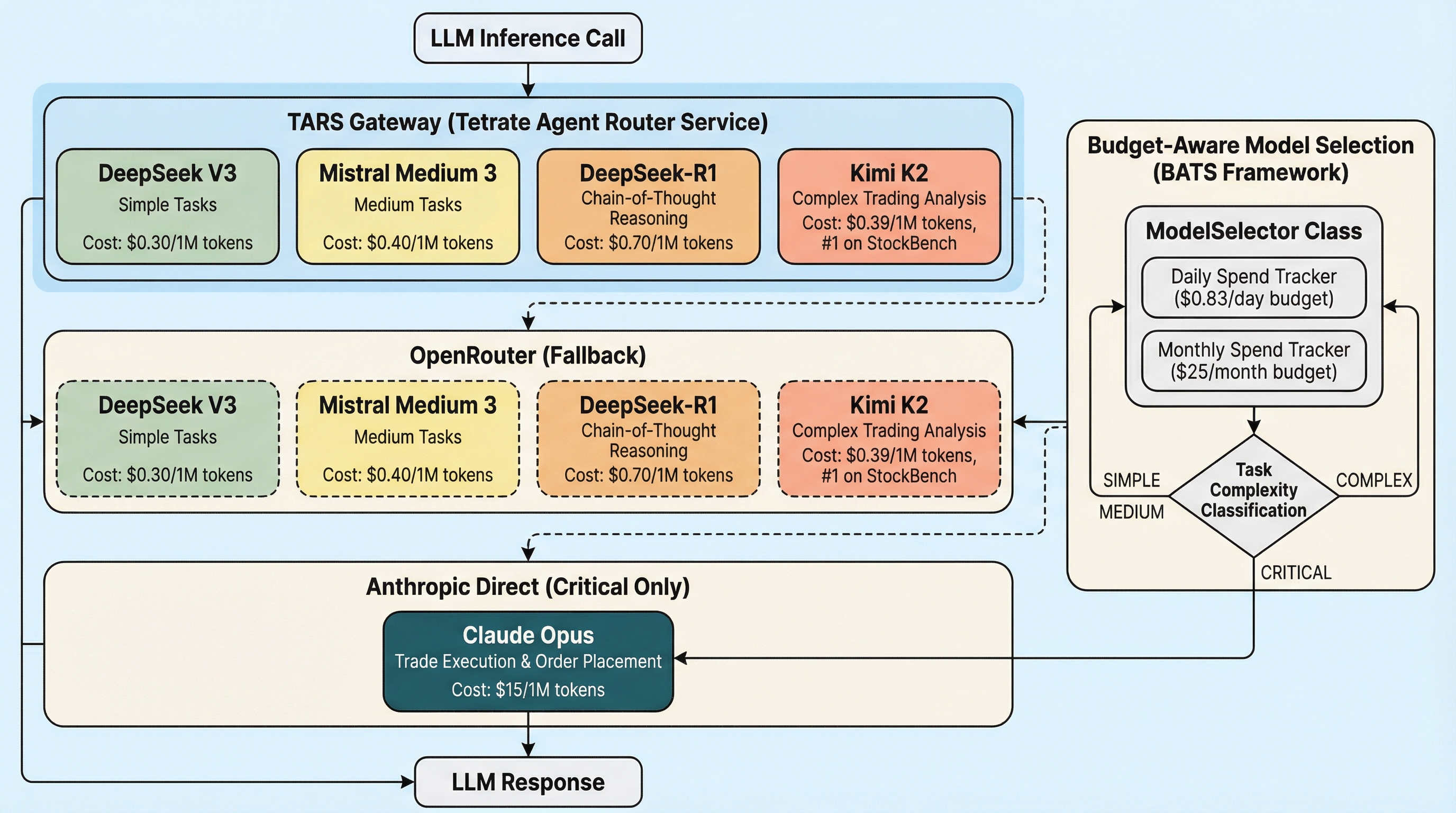
One API key. One base URL. Five models across three providers. The trading code doesn’t know or care which model handles a request — it calls the gateway, and the gateway routes.
# src/utils/llm_gateway.py — the entire integration

## Answer Block

> **Answer Block:** Running an AI trading system is expensive. If every LLM call uses Claude Opus ($15 input / $75 output per million tokens), a moderately active system burns thro

def resolve_openai_compatible_config(
    *, default_api_key_env, default_base_url
):
    base_url = get_llm_gateway_base_url() or default_base_url
    api_key = get_llm_gateway_api_key() or _get_env(default_api_key_env)
    return OpenAICompatibleConfig(api_key=api_key, base_url=base_url)
Budget-Aware Model Selection (BATS)
Our ModelSelector implements what we call the BATS framework — Budget-Aware Test-time Scaling:
| Task | Model | Cost | Why |
|---|---|---|---|
| Parse market data | DeepSeek V3 | $0.30/$1.20 | Fast, cheap, good enough |
| Analyze technicals | Mistral Medium 3 | $0.40/$2.00 | 90% of Sonnet quality at 8x less |
| Options structure | Kimi K2 | $0.39/$1.90 | #1 on StockBench trading benchmark |
| Pre-trade reasoning | DeepSeek-R1 | $0.70/$2.50 | Chain-of-thought for entry timing |
| Execute trade | Claude Opus | $15/$75 | Never cost-cut on money decisions |
Daily budget: $0.83. Monthly budget: $25. Compare to $500+/month with Opus-only.
The Safety Guarantee
One rule is absolute: trade execution always uses Claude Opus. The ModelSelector enforces this at the code level:
if complexity == TaskComplexity.CRITICAL:
    selected = MODEL_REGISTRY[ModelTier.OPUS]
    return selected.model_id  # No budget check, no downgrade
You can exhaust the entire daily budget on analysis calls. The next trade execution still uses Opus. Phil Town Rule #1: don’t lose money. That means don’t cheap out on the model that decides where your money goes.
Automatic Fallback Chain
If budget runs low, the selector downgrades gracefully:
Opus → Kimi K2 → Mistral → DeepSeek
TARS adds a second layer of fallback at the gateway level — if Anthropic’s API is down, TARS can auto-route to Google or another provider. Two layers of resilience, zero code changes.
The Trading Pipeline
Every trade passes through six stages, each with its own model routing:
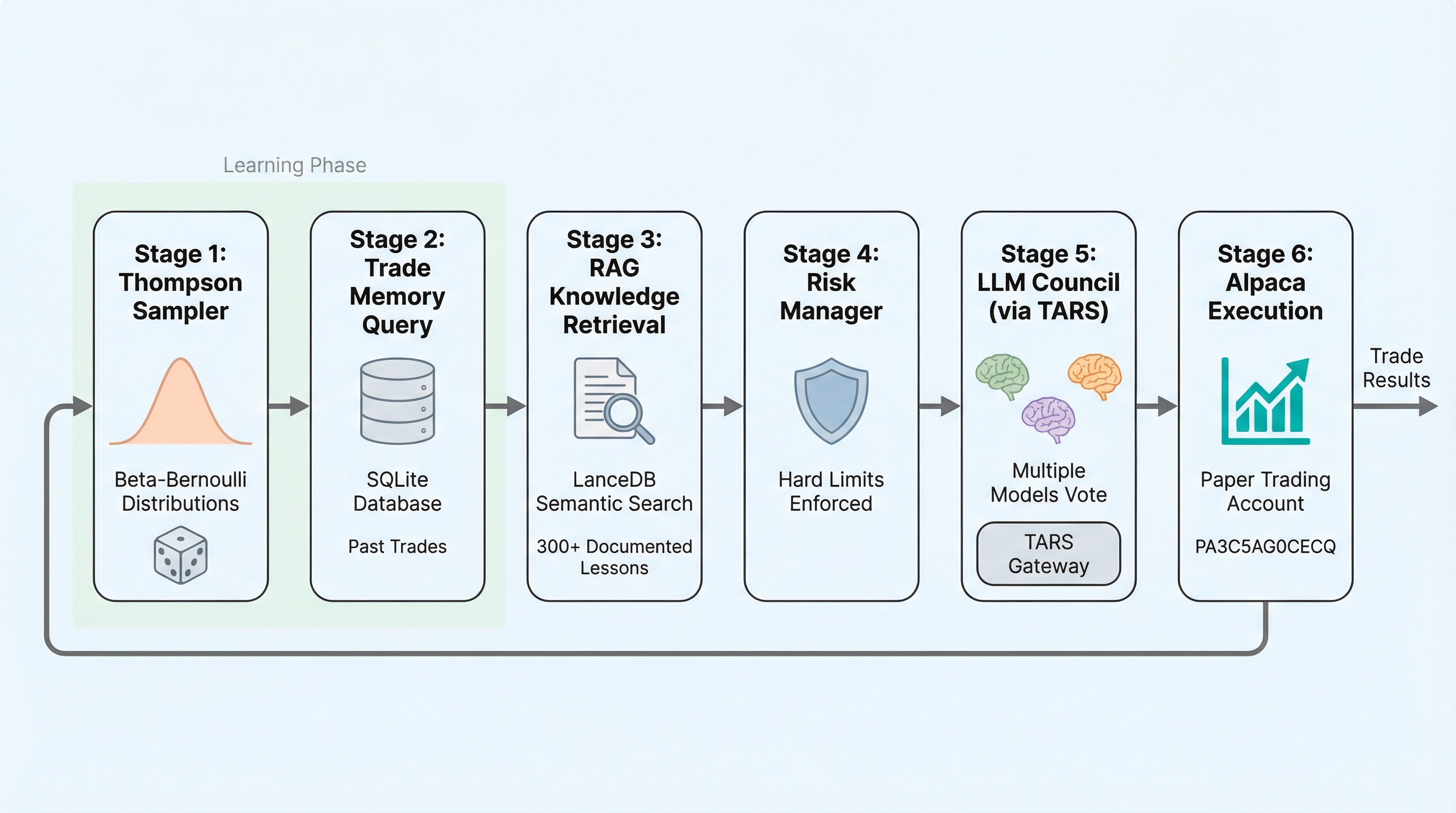
- Thompson Sampler — strategy selection (local, no LLM)
- Trade Memory — SQLite pattern matching (local)
- RAG Knowledge Retrieval — LanceDB semantic search over 300+ lessons (embedding via TARS)
- Risk Manager — hard limit enforcement (local)
- LLM Council — multiple models vote on the trade (DeepSeek-R1 + Kimi K2 via TARS)
- Alpaca Execution — order placement (Opus via Anthropic Direct)
Stages 3 and 5 route through TARS. Stage 6 goes direct to Anthropic. Everything else is local computation — no LLM cost.
Results
- Monthly LLM cost: ~$25 (down from projected $500+ with single-model approach)
- Model diversity: 5 models across 3 providers, automatically selected per task
- Safety: Trade execution always uses the best model, regardless of budget
- Resilience: Two-layer fallback (BATS downgrade + TARS gateway fallback)
- Observability: TARS request logs + usage dashboard for cost tracking
Getting Started with TARS
# .env configuration
LLM_GATEWAY_BASE_URL=https://api.router.tetrate.ai/v1
TETRATE_API_KEY=sk-your-key-here
That’s it. The gateway resolves automatically in llm_gateway.py. Every OpenAI-compatible call in the system routes through TARS with zero code changes.
Built for the Tetrate AI Buildathon. This post is part of our AI Trading Journey.
Evidence: https://github.com/IgorGanapolsky/trading